
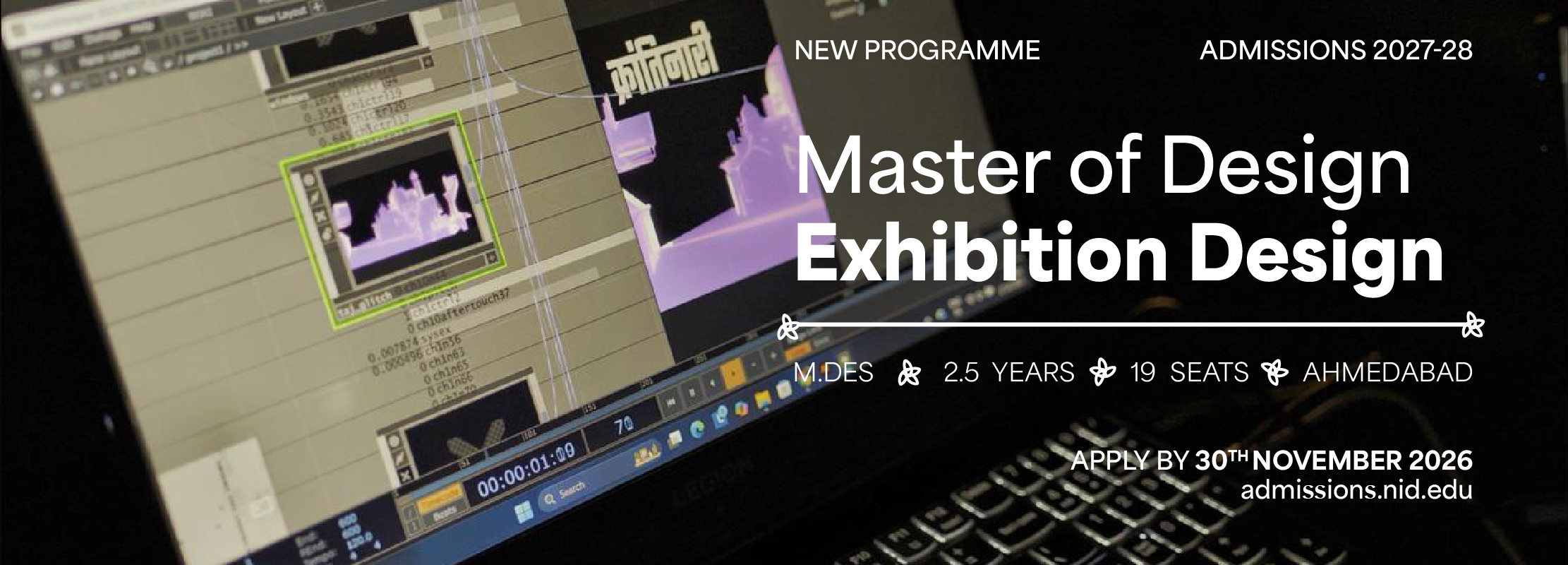
The Masters in Exhibition Design is a multidisciplinary program that sits at the cusp of design of space, communication, making and media. It deals with spatial storytelling and world building, spatial communication and experience creation. We work across modalities of formal explorations & contexts- museums, trade fairs, scenographies, & theatres; always aware of the heritage, & cultural significance of creating public commons which is both sensorial & affective.
The program provokes and facilitates independent and critical thinking, with a learner centric approach of building one’s agency in a wide possibility of direction - from developing conceptual depth, honing professional industry specific skills or creating frameworks for research. Participatory frameworks, Critical Design and Speculative Futures are some of the pedagogic tools which feature extensively over the three years in Exhibition Design. By blending technological and tactile skills of making, the discipline curriculum responds to and is constantly informed by a future oriented approach.
The discipline has core theoretical inputs that build the framework while studio courses and design projects ensure the integration of theoretical understanding and practical application in contextual scenarios. The curriculum also focuses on a varied range of skills building - on the one hand - intellectual and practical skills of visualization, representation, understanding and handling complex media and material and on the other hand - working skills for collaborative practices, working with a vast array of teams and experts, people management skills, and understanding how these complex industries work. There is a lot of emphasis on exposure to the professional industry of spatial experience design which eventually builds the primary career pathways.
The career opportunities include the exhibition and pavilion design industry, set and scenography design for theatre, film and OTT platforms as well as for the event industry, design of permanent communicative spaces such as museum galleries and experience centres and also other opportunities involving spatial communication such as signage design, environmental branding and virtual space and experience building for virtual museums and in the digital game industry.
We encourage students not only to plug in relevant areas of the industry in the domains of their interest, but also to build agency to build their own area of work as entrepreneurs.
Built on the legacy of over four decades as an undergraduate programme, this discipline has successfully collaborated with various national and international institutions such as LAMO, National Council of Science Museum, Agastya Foundation, Sahapedia, Serendipity Arts Foundation, Science Gallery Bengaluru, ENSCi-Les Ateliers, Paris, SOA+D, KMUTT, Bangkok and the like.
Read MoreName of the Event
Ahmedbad Campus | 12 Oct 19 - 12 Jan 19

The identity of this book edited by the late I.S. Mathur is established by its leitmotif—training the teachers of design or educating the design educators. This book is divided into three major sections—‘Retrospection’, ‘Introspection’, and ‘Perception’. A mélange of thoughts, experiences, and anecdotes expressed by alumni, faculty both former and present, and artists—this book touches upon poignant issues which can influence the spread of design education across design schools/institutions in India.
The identity of this book edited by the late I.S. Mathur is established by its leitmotif—training the teachers of design or educating the design educators. This book is divided into three major sections—‘Retrospection’, ‘Introspection’, and ‘Perception’. A mélange of thoughts, experiences, and anecdotes expressed by alumni, faculty both former and present, and artists—this book touches upon poignant issues which can influence the spread of design education across design schools/institutions in India.