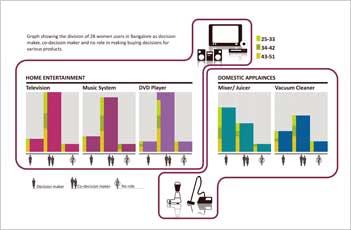
To drive the emerging Indian market, technology providers are providing more and more features in their products. However, many Indian consumers feel overloaded by the complexity of these products, in terms of the way they interact with the product. The project looked at establishing new ways of interacting with home entertainment products and structuring information in the products themselves; thus enabling a hassle free and intuitive experience for the Indian user.
I spent much time on user research and analysis, multiple rounds of interviews to understand users’ concept of technology, and a novel technique called ‘cultural probes’ to make the research process more activity based. All this helped study current trends. I incorporated insights from these techniques in interaction between the on screen display of a home entertainment system and its controlling devices. Explorations were then combined and refined into final design concepts. These concepts were quickly prototyped and tested with some prospective users. Important feedback was then incorporated into the final design.
As an information designer, the project proved to be an excellent opportunity to reduce complexity in technology based products and make them usable, even by people who are not technology savvy. I realised that home entertainment is a vast field, and presents a large number of design opportunities and challenges. Apart from design, I learnt about the amazing technology of Philips. |